Ideas are sneaky little things.
They rarely arrive when the desk is clean, the coffee is hot, the dogs are sleeping, and I have several uninterrupted hours waiting politely for something creative to happen.
No.
They tend to show up when I’m doing something completely unrelated.
A sentence pops into my head while I’m working on a website.
A character suddenly develops a personality while I’m trying to fix a picture.
A color combination gives me an idea for something that has absolutely nothing to do with the project I’m supposed to be finishing.
And then there are the dangerous words:
“Oh, that would be cute.”
That sentence has started more projects around here than I care to admit.
The idea is usually the easy part
Beginning something new is fun.
At the beginning, everything still works perfectly because almost none of it exists yet.
The story sounds wonderful in my head.
The illustration looks beautiful in my imagination.
The title is clever.
The characters cooperate.
Nothing has been formatted incorrectly.
Nobody has six fingers.
The dog is standing on the floor instead of somehow floating three inches above it.
It is a lovely time.
Then I actually start making the thing.
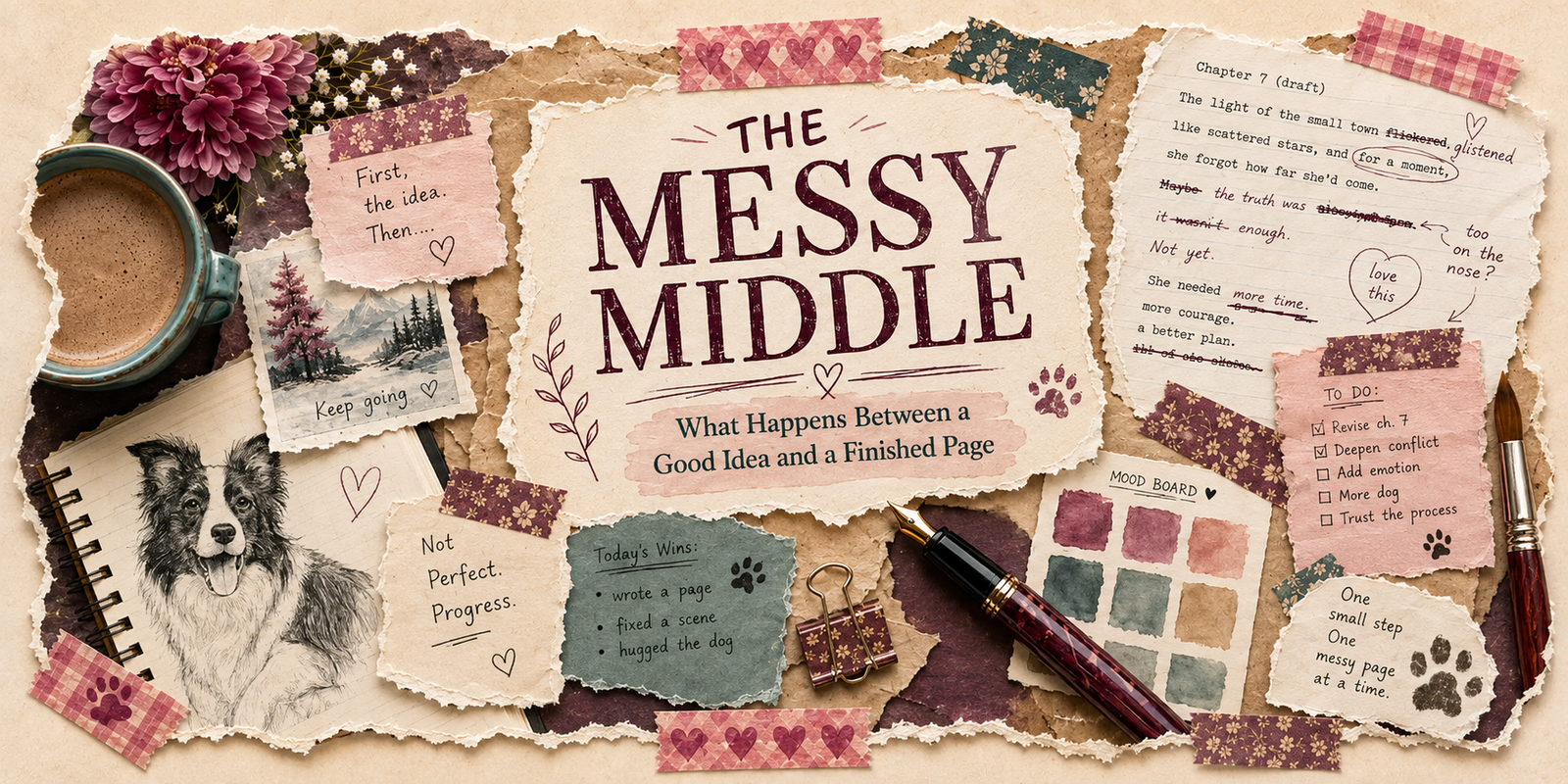
That is when the messy middle begins.
The story starts asking questions
A simple idea can turn into an unreasonable number of decisions very quickly.
For a children’s book, even a short scene can bring up questions like:
- Would a child really say this?
- Is the sentence too long?
- Does the illustration already show what the text is explaining?
- Is the animal’s behavior believable?
- Does the child actually get to make a choice?
- Is the page getting preachy?
- Is this funny, or do I only think it’s funny because I’ve been staring at it for four hours?
- Why is that chair suddenly a different color?
The glamorous life of an author.
I am beginning to suspect that writing a book is mostly answering hundreds of tiny questions nobody will ever know existed.
And that’s probably how it should be.
The reader shouldn’t see all the scaffolding.
They should simply enjoy the story.
Pictures have their own opinions
Illustration brings another entire layer of decisions.
I can have a picture that is technically correct and still not like it.
Maybe the room feels too empty.
Maybe the character’s expression doesn’t fit the moment.
Maybe the dog looks worried when he should look relaxed.
Maybe the colors are fighting each other.
Maybe an object in the background suddenly becomes the most noticeable thing on the entire page even though nobody invited it to be important.
This is one reason I can spend so much time changing small details.
A tiny change can completely alter the feeling of a scene.
Move an animal a little farther away.
Lower a child’s hand.
Open a doorway.
Remove an unnecessary object.
Change an expression.
Suddenly the picture tells the story better.
That part fascinates me.
AI makes things faster. It does not make them automatic.
I use AI tools as part of my illustration process now, and I love what they allow me to do.
I can try an idea quickly.
Change the composition.
Experiment with another room.
Test different colors.
See whether a scene works before spending forever on it.
But there is a funny misconception that using AI means you type a sentence, receive the perfect picture, and go have lunch.
I would like to meet the person whose computer is doing that.
Mine apparently did not receive the memo.
Sometimes an image is wonderful except for one bizarre detail.
Sometimes fixing that detail creates three new ones.
Sometimes the dog changes breed halfway through the scene.
Sometimes furniture appears to have been designed by someone who has only heard rumors about houses.
And text inside images?
That deserves its own support group.
The speed is wonderful.
The judgment still matters.
You have to know when something works, when it almost works, and when it needs to go directly into the digital trash can despite the amount of time you spent trying to save it.
There is a point where I start questioning everything
This happens with almost every creative project.
At some point, I look at the thing I’ve been working on and think:
Is this actually any good?
This is not usually a useful stage.
Unfortunately, it appears to be mandatory.
The problem is that once you’ve looked at something long enough, you stop seeing it normally.
You see every sentence you rewrote.
Every picture you rejected.
Every compromise.
Every tiny thing that still bothers you.
Meanwhile, someone seeing it for the first time sees the whole thing.
That difference matters.
Sometimes the answer isn’t another major change.
Sometimes the answer is simply walking away for a while and coming back with fresh eyes.
The dogs have a simpler creative process
Their system appears to be:
- Wake up.
- Check whether food exists.
- Follow me somewhere.
- Lie down directly where I need to walk.
- Request food again.
- Sleep through all difficult creative decisions.
It is remarkably efficient.
They have never once worried about typography.
I envy them.
Eventually, something starts to click
There is usually a moment when the project stops feeling like a collection of pieces and begins feeling like one thing.
The words and pictures belong together.
The colors settle down.
The character feels right.
The page finally says what it was supposed to say.
That is the part I love.
Not because everything is perfect.
It never is.
But because the thing that only existed in your head now exists somewhere outside of it.
You can see it.
Someone else can see it.
That’s still a little magical to me.
Finished does not mean flawless
This is one I have to remind myself of.
A project can always be changed.
Another sentence can always be rewritten.
Another illustration can always be adjusted.
Another color can always be tested.
At some point, though, creating turns into endlessly rearranging the furniture.
You have to decide that the story works.
The picture works.
The heart of the thing is there.
And then you have to let it go.
I am excellent at the first part.
I am working on the second.
So if the desk looks messy…
There is probably a reason.
Somewhere between the first idea and the finished book are notes, discarded versions, strange experiments, little victories, very questionable pictures, good surprises, and more second-guessing than anyone will ever see.
That messy middle isn’t a sign that something has gone wrong.
Most of the time, that’s where the real work is happening.
And sometimes, buried underneath all those revisions, you find the version you were trying to make from the beginning.
♡ Wynter
